In a real-world study, multimodal artificial intelligence models outperform PD-L1 across key endpoints
Combining radiomics from computerised tomography (CT) scans with real-world clinical data improved survival prediction in patients with non-small cell lung cancer (NSCLC) treated with immunotherapy, outperforming PD-L1 across multiple endpoints, according to study findings published in the ESMO Real World Data and Digital Oncology (ESMO Real World Data and Digital Oncology, Volume 10, 100182 ).
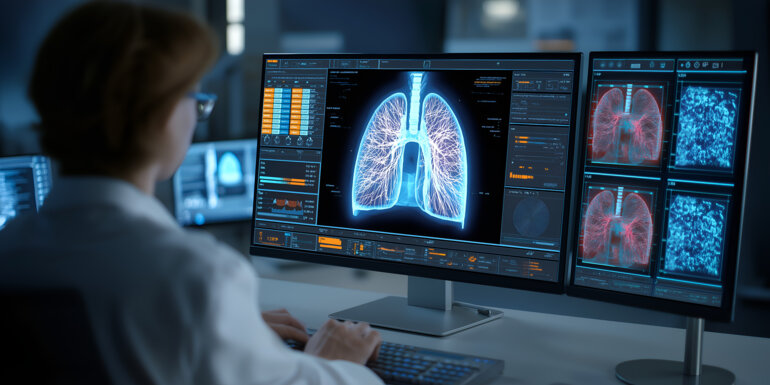
In the observational, retrospective, monocentric, real-world study, three sets of features – radiomic data (R), real-world data (RWD) (i.e. clinical data retrieved from patients’ electronic health records), and R + RWD – from a large-scale cohort of 375 patients with stage IV or recurrent NSCLC were analysed using four different machine learning (ML) classifiers for each of the three established endpoints – clinical benefit rate (CBR), overall survival status at 6 months (OS6) and overall survival status at 24 months (OS24).
“The best model predicted OS24 with 71% accuracy and an area under the curve (AUC) of 0.79, highlighting the added value of imaging-derived features,” notes Dr Rodrigo Dienstmann, working at the Oncoclínicas & Co, Brazil, and Vall d’Hebron Institute of Oncology, Spain, and Editor-in-Chief of the ESMO peer-reviewed journal. Although the AUC difference when comparing the multimodal model with RWD-only and PD-L1 was not statistically significant except for CBR endpoint, a consistent trend favouring the combined feature set emerged for both the survival endpoints (AUC 0.76 versus 0.64 versus 0.54 with R + RWD, RWD, and PD-L1 feature sets for the OS6 endpoint; AUC 0.79 versus 0.72 versus 0.56 for the OS24 endpoint).
Both the radiomic and the multimodal models outperformed the prediction performances of the categorised PD-L1 expression, which is currently the only validated biomarker used in clinical practice for selecting appropriate immunotherapy treatment. However, it presents some limitations associated with tissue sampling, and there is a urgent need of non-invasive, easy-to-use and efficient methods for predicting response to treatment and stratify patients.
“In the study, explainability analysis confirmed that both clinical and radiomic variables drive prognostic performance,” concludes Dienstmann. “These findings pave the way for more personalised immunotherapy strategies.”