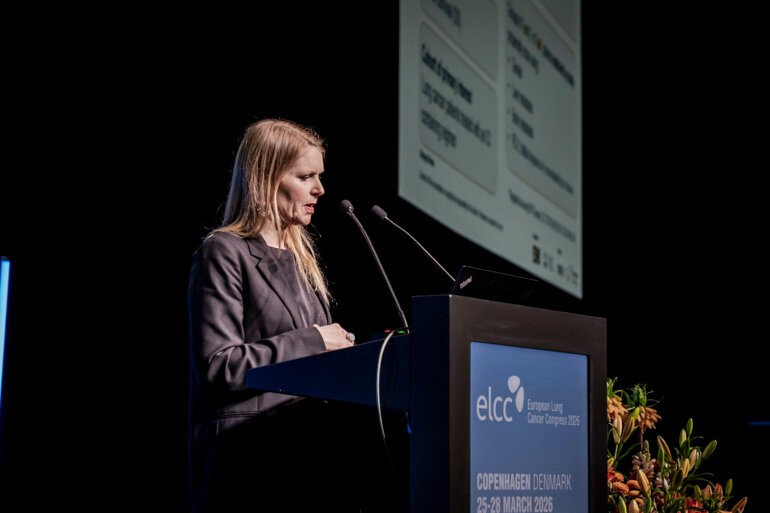


Understanding the evolution of immunotherapy resistance holds the key to developing novel strategies in NSCLC
Immunotherapy forms part of first-line therapy for many patients with non-small cell lung cancer (NSCLC) lacking targetable mutations, but there are several issues around overcoming resistance to these agents, most of which relate to heterogeneity of the disease.
NSCLC can vary between patients and even within the same patient, including before and after immunotherapy. Analysis of this tumour type in patients using multiplexed imaging mass cytometry has revealed variance in tumour cell subtypes on treatment with immunotherapy, with T-cell infiltration associated with acquisition of resistance to immune checkpoint inhibitors (Nat Comm. 2023;14:5154). Research into the mechanisms of immunotherapy resistance in other solid tumours suggests a role for both tumour-intrinsic processes, such as neoantigen loss and antigen presentation defects, as well as factors involving the tumour microenvironment, such as immune evasion strategies, extracellular remodelling and upregulation of inhibitory molecules (Trends Mol Med. 2025;31:1008–1020).
A key drawback in the development of treatments to overcome acquired resistance to immunotherapy in NSCLC is that clinical trials are designed without considering the profound tumour and tumour microenvironment heterogeneity. Furthermore, preclinical models lack the intricacies of this heterogeneity to truly mimic the setting in which resistance arises. As a result, it is extremely difficult to develop a preclinical test that can accurately predict which therapeutic combination will overcome the specific, diverse resistance mechanisms, leading to a gap between preclinical studies and successful clinical trials.
Results for combination therapy with ceralasertib – a selective inhibitor of the ataxia-telangiectasia-related (ATR) DNA damage response kinase – plus durvalumab in the phase III LATIFY study presented at the European Lung Cancer Congress 2026 (Copenhagen, 25–28 March) showed that among 594 patients randomised, no improvement in overall survival (OS) was reached compared with the standard of care, docetaxel, with objective response rates (ORRs) of 7.7% and 17.3%, respectively (LBA1). Patients had locally advanced or metastatic NSCLC, no actionable genomic alterations, and disease progression on or after anti-PD-(L)1 and platinum-based chemotherapy. This result was not unexpected given the previous phase II results of this combination in the HUDSON study, which demonstrated an ORR of 13.9% (Nat Med. 2024;30:716–729). The disappointing phase III results stress the need for alternative strategies to overcome the development of acquired resistance to immunotherapy. We need to understand at the molecular level the evolution of resistance development, which requires that tumours are re-analysed at times of resistance to immunotherapy, creating opportunities for more personalised treatment strategies.
Interesting results from a second phase III study presented in Copenhagen, PRESERVE-003, showed an ORR of 20.0% with gotistobart, an anti-CTLA-4 monoclonal antibody, and 4.8% with docetaxel (which is lower than expected) in 87 patients with advanced or metastatic squamous NSCLC who had disease progression on or after anti-PD-(L)1 and platinum-based chemotherapy (Abstract 3O). Median OS was not reached in the gotistobart arm compared with 9.95 months in the docetaxel arm after a median follow-up of 14.5 months and 15.2 months, respectively. PRESERVE-003 is an ongoing study and we anticipate further results for gotistobart in this setting.
Both of these studies demonstrate the challenge of overcoming acquired resistance to immunotherapy and underline the difficulty in our current lack of a tailored strategy and treatment options for this patient population. Further strategies being explored to overcome resistance to immunotherapy in NSCLC take advantage of the evolution in technology that allows rapid analysis of tumours and the tumour microenvironment. Previously, several phase III trials combining multi-TKI and immunotherapy have failed to demonstrate an OS benefit in this population of patients. However, some phase II studies have shown promising ORR (SAKK 17/18 [Ann Oncol. 2023;34(Suppl. 2):S807–S808] and RECLAIM [J Thoracic Oncol. 2025;20(Suppl. 1):S610]) and further developments with these approaches are under investigation. Antibody–drug conjugate-based strategies have recently emerged, but today we still lack markers to guide treatment decisions in this complex field. Advances in technologies that identify predictive biomarkers in patient samples should be leveraged to deepen our understanding of immunotherapy resistance, guide the design of rational clinical trials, and ultimately improve patient outcomes.
Programme details
Besse B, et al. Ceralasertib (C) + durvalumab (D) in patients (pts) with locally advanced (LA) or metastatic (m) NSCLC who progressed on or after anti-PD-(L)1 and platinum-based chemotherapy (CT): Results from LATIFY. European Lung Cancer Congress 2026 - LBA1
He K, et al. Anti-tumor activity of gotistobart compared to docetaxel in patients with metastatic squamous non-small cell lung cancer (sqNSCLC) progressing on PD-(L)1 inhibitors: Stage 1 PRESERVE-003 phase III trial. European Lung Cancer Congress 2026 - Abstract 3O