Recent studies support treatment optimisation for improving patients’ quality of life, but its implementation in clinical practice remains limited
The idea that a less intensive chemotherapy regimen is associated with improved quality of life for patients, without compromising clinical outcomes, is today increasingly accepted in breast cancer. For decades, the predominant approach in oncology has been escalation – i.e., adding therapies such as chemotherapy agents, ovarian suppression in young women, CDK4/6 inhibitors, and extending endocrine treatment beyond 5 years to maximise tumour control, often leading to unnecessary toxicities and treatment burden.
Accumulating evidence is beginning to challenge this old paradigm, and prospective trials are ongoing to look at multimodal strategies to de-escalate treatments. For instance, in early-stage HER2-positive breast cancer, recent findings showed that removing carboplatin from the chemotherapy backbone in the neoadjuvant setting, combined with dual HER2-blockade (trastuzumab and pertuzumab), produced the same pathological complete (pCR) and overall response rates as the standard regimen (J Clin Oncol. 2026:JCO2502176).
While only a few biomarkers have so far been validated to guide chemotherapy optimisation – mainly gene expression assays and endocrine response assessment – early imaging-based strategies such as positron emission tomography (PET) or magnetic resonance imaging (MRI) during neoadjuvant therapy have emerged as novel potential tools to identify those patients who may be eligible for less intense treatments. The TRAIN-3 trial demonstrated that a complete radiological response on MRI may help identify early responders to neoadjuvant systemic therapy among patients with stage II–III hormone receptor (HR)-negative and HER2-positive breast cancer, enabling a reduction in the number of cycles (Lancet Oncol. 2024;25:603–613). In the PHERGain study, a PET-guided, pCR-adapted strategy was associated with a high 3-year invasive disease-free survival (iDFS) rate in patients with HER2-positive early breast cancer who omitted chemotherapy (Lancet. 2024;403:1649–1659).
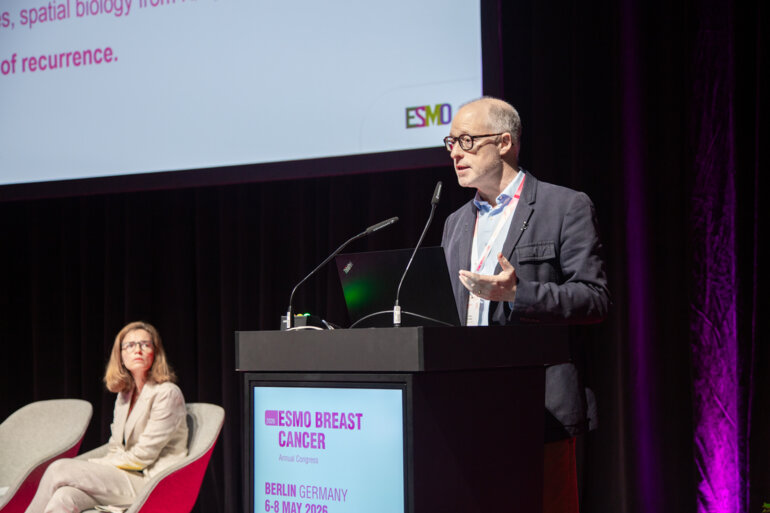
Further supporting the feasibility of this strategy, results from the PHERGain-2 study (Abstract 214O), as presented at the ESMO Breast Cancer 2026 congress (Berlin, 6–8 May), remind us what the ultimate goal of investigating novel ways of treatment optimisation is: it is not to de-escalate treatment per se, rather, it is to offer our patients a clinically meaningful preservation of their quality of life in the long term without compromising their prognosis.
These approaches have not entered standard clinical practice yet, and larger studies are now needed not only to move treatment optimisation to the next level, but also to increase its uptake in the real-world setting.
Presented at the congress, results of a survey among oncologists across 38 countries described a scenario that is far from ideal in Europe: despite recognition among the oncology workforce of the importance of biomarker-guided de-escalation in early-stage HER2-positive breast cancer, treatment optimisation is still implemented inconsistently (Abstract 223P). Reasons are multiple, including the availability and costs of tests, and reimbursement restrictions. These barriers may be tackled with more solid evidence from prospective research. The breast cancer community is at a critical transition point. Moving forward, treatment optimisation must extend beyond HER2-positive disease and be embraced across all breast cancer subtypes. In HR-positive disease, there remains a clear need to better identify patients who may safely forgo chemotherapy or avoid unnecessary escalation of endocrine therapy. Likewise, in the population with triple-negative breast cancer, there may be patients, such as those carrying BRCA pathogenic or likely pathogenic variants, who may benefit from more tailored approaches and less from conventional chemotherapy regimens.
This evolution also underscores novel priorities for research. As new therapies such as antibody–drug conjugates and their combinations enter clinical practice, their long-term impact on quality of life must be carefully evaluated. Outcomes such as chronic toxicities, including their impact on fertility and ovarian function in young women, are essential for truly informed, patient-centred decision-making and should be systematically integrated into future clinical studies.
Programme details
Llombart Cussac A, et al. Chemotherapy-free, pathological complete response (pCR)-guided strategy with trastuzumab-pertuzumab (HP) and T-DM1 in HER2+ early breast cancer (EBC): PHERGain-2. ESMO Breast Cancer 2026. Abstract 214O
Rapesta G, et al. Health policy and real-world strategies in early-stage HER2-positive breast cancer: results from an international survey within the DEFINITIVE project. ESMO Breast Cancer 2026. Abstract 223P