
Rapid advances in molecular targeting, immunotherapy optimisation and novel drug classes are reshaping gastrointestinal oncology
Progress in gastrointestinal (GI) cancers, most notably in tumours characterised by microsatellite instability (MSI), has been driven for many years by immune checkpoint inhibitors delivering meaningful benefit in these subgroups (N Engl J Med. 2015;372:2509–2520; Science. 2017;357:409–413). The therapeutic landscape is now entering a new phase, shaped by advances that extend beyond immunotherapy and into targeted and molecularly driven strategies. Among these, the emergence of KRAS inhibitors represents a pivotal step forward. Historically considered ‘undruggable’, KRAS has now become a viable target, opening new opportunities across GI malignancies.
A key milestone in this field is the RASolute 302 trial, which evaluated the oral RAS(ON) multiselective inhibitor daraxonrasib in patients with previously treated pancreatic ductal adenocarcinoma (PDAC) harbouring KRAS G12 mutations (N Engl J Med. 2026 May 31). In this study, median overall survival reached 13.2 months with daraxonrasib compared with 6.6 months with chemotherapy (hazard ratio for death 0.40; 95% confidence interval 0.30–0.53; p<0.001), marking a substantial improvement in a disease with historically limited options.
Colorectal cancer (CRC), together with PDAC, represent an area where KRAS-directed strategies are progressing most rapidly. Early clinical data have already demonstrated the activity of first-generation KRAS G12C inhibitors (Cancer Discov. 2024;14:982–993; N Engl J Med. 2023;389:2125–2139) and further advances are anticipated.
At this year’s ESMO Gastrointestinal Cancers Congress, results from the phase III KRYSTAL-10 trial (LBA1), evaluating adagrasib plus cetuximab versus chemotherapy in KRAS G12C-mutated CRC, provide important insights into this approach. In parallel, early-phase data with next-generation agents such as calderasib from KANDLELIT-001 (Abstract 6RO) will contribute to defining the future treatment landscape.
But, KRAS G12C mutations account for only 3–4% of CRC cases, highlighting the need to expand beyond this subset. The development of pan-KRAS inhibitors and agents targeting more prevalent variants such as G12D and G12V is therefore eagerly awaited. Multiple early-phase trials are underway, reflecting intense efforts to broaden the impact of KRAS-targeted therapies and bring benefit to a larger proportion of patients with RAS-mutant disease.
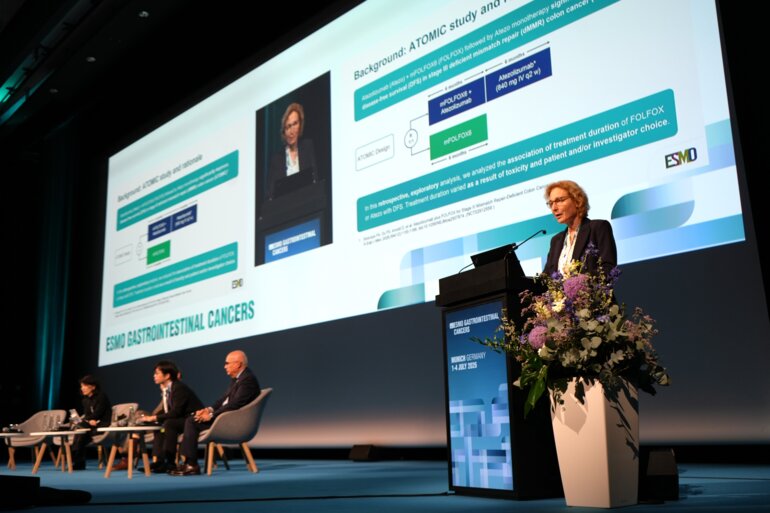
Another important area of discussion is the optimisation of immunotherapy use in MSI-high CRC. Results from the ATOMIC trial (Abstract 1O) address the duration of chemotherapy and immunotherapy, an unresolved question across settings, from metastatic disease to adjuvant and neoadjuvant therapies. Determining the optimal duration is critical not only to maximise efficacy but also to reduce overtreatment, minimise toxicity and improve the sustainability of healthcare systems.
Antibody–drug conjugates are also emerging as a rapidly expanding class in GI oncology. Several targets are currently being explored, including HER2, CEACAM and CLDN18.2, with additional candidates entering early-phase development. As seen in other tumour types, the field is expected to quickly move from single-agent activity towards combination strategies and sequencing approaches, which will likely define the next wave of clinical research in GI cancers.
Underpinning all these advances is the critical role of translational research. Identifying predictive biomarkers of response and resistance remains essential to guide treatment selection and optimise outcomes. New technologies, such as circulating tumour DNA, single-cell analyses and spatial omics, are providing unprecedented insights into tumour biology. At the same time, the integration of artificial intelligence is enhancing our ability to interpret complex clinical and multi-omic datasets, paving the way towards truly personalised care.
Taken together, these developments signal a meaningful shift in GI oncology. What was once a field with limited targeted options is now rapidly evolving, with multiple innovative strategies converging to improve patient outcomes.