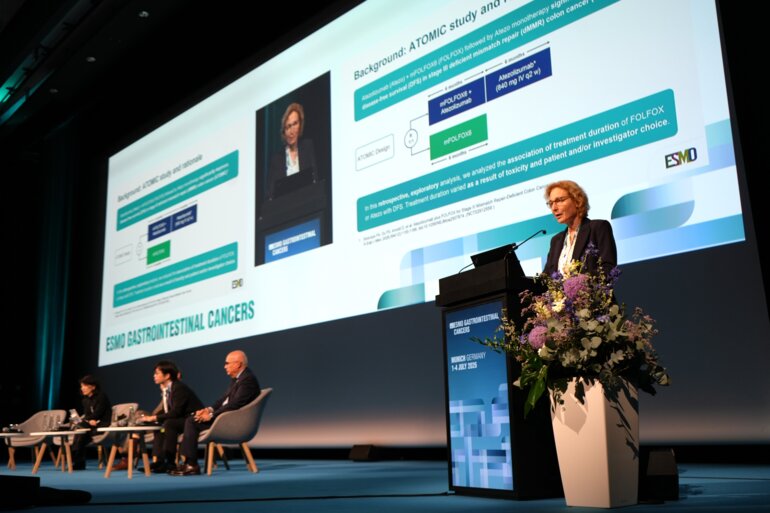


ADCs are transforming the management of patients with GI cancers, but novel targets and combination strategies will be required to address resistance development and optimise patient outcomes
Gastrointestinal (GI) cancers have historically proved challenging to treat with targeted therapies; beyond tumours characterised by high HER2 or BRAF expression, and a small number of microsatellite instability-high cases, treatment has primarily relied on chemotherapy-based combinations. Recently, the antibody–drug conjugate (ADC) trastuzumab deruxtecan has been associated with significantly improved survival outcomes compared with chemotherapy in patients with HER2-positive gastric and gastro-oesophageal cancers progressing on trastuzumab-based therapy (N Engl J Med. 2025;393:336–348; J Pers Med. 2026;16:195).
The heterogeneous microenvironment of GI tumours, with highly variable antigen expression, make ADC therapies particularly well suited due to their bystander effects that enable the destruction of nearby tumour cells via payload diffusion, regardless of their antigen expression status (Expert Opin Investig Drugs. 2025;34:953–956; Crit Rev Oncol Hematol. 2025;216:104979). However, ADCs can be associated with a specific and clinically significant toxicity profile that includes interstitial lung disease (Curr Oncol. 2025;32:575) and severe cytopenias (Expert Opin Drug Saf. 2026;25:767–775), requiring individualised toxicity monitoring. In addition, many patients become resistant to treatment, with loss of HER2 expression occurring in a high proportion of cases (Cancers (Basel). 2024;16:2854). There is a reliance on one or two ADC payloads, and data on cross-resistance are limited so it is difficult to predict whether patients who progress after a first ADC will benefit from a second ADC.
Novel targets and combination strategies with chemotherapy and immunotherapy are likely to be required to further improve patient outcomes, but the potential for cumulative toxicity is a concern. ADCs targeting CLDN18.2, TROP2, and CEACAM5 are currently in clinical development, suggesting that these agents will continue to expand across GI cancer treatment algorithms.
At the ESMO Gastrointestinal Cancers Congress 2026 (Munich, 1–4 July), encouraging interim data were presented with the anti-CEACAM5 ADC precemtabart tocentecan (Precem-TcT) in 46 patients with refractory (second- or third-line) pancreatic ductal adenocarcinoma (PDAC) and high CEACAM5 expression treated in the phase Ib/II PROCEADE®-PanTumor trial (Abstract 345RO). In the second-line cohort, the confirmed objective response rate was 24.0% and, after a median follow-up of 6.8 months, median progression-free survival was 5.3 months. Treatment-emergent adverse events led to permanent discontinuation of Precem-TcT in 6 patients (13%), with no cases of interstitial lung disease and no treatment-related deaths.
These second-line data are comparable to those reported with other ADCs in this setting (Ann Oncol. 2025;36(Suppl 2):S1145; J Clin Oncol. 2025;43(Suppl 16):4017), suggesting a signal is present in this small study with a selected patient cohort. Notably, most patients had previously received the topoisomerase I (top1) inhibitor irinotecan and still responded to the Precem-TcT top1 payload (exatecan), suggesting a lack of cross-resistance.
Precem-TcT has previously showed a manageable safety profile and promising efficacy in the phase I PROCEADE-CRC-01 study of patients with metastatic colorectal cancer (mCRC) (Nat Med. 2025;31:3504–3513; J Clin Oncol. 2026;44(Suppl 2):129). A phase III trial of Precem-TcT with/without bevacizumab compared with trifluridine/tipiracil (PROCEADE®-CRC-03; NCT07549412) is currently ongoing in patients with previously treated mCRC.
As experience and understanding relating to the optimal use of ADCs in GI cancers evolves, these agents will undoubtedly move out of the refractory setting into earlier treatment lines where they have the potential to positively impact survival. Payloads will broaden beyond top1, while dual-targeting and bispecific constructs aimed at tumour heterogeneity will become an increasing focus for clinical development. Quantitative antigen measurement and circulating tumour DNA detection to indicate response will also enable ADCs to be used more selectively. The question is shifting from whether ADCs work to who they work for, in what order and in what combination, which is a much better problem to have.
Programme details
Smyth E. Antibody Drug Conjugates in GI cancer - ESMO Gastrointestinal Cancers Congress 2026 Keynote lecture
Wainberg ZA, et al. Precemtabart tocentecan (Precem-TcT) in patients with metastatic pancreatic ductal adenocarcinoma (mPDAC): Results from the Phase Ib/II PROCEADE-PanTumor PDAC substudy. ESMO Gastrointestinal Cancers Congress 2026 - Abstract 345RO