The phase III KRYSTAL-10 trial did not meet its co-primary survival endpoints
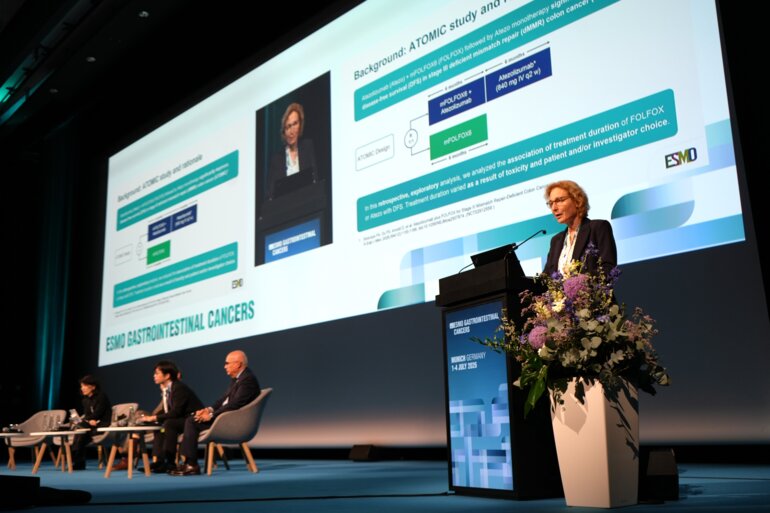
The chemotherapy-free regimen of the selective KRAS G12C inhibitor, adagrasib, plus cetuximab, a chimeric IgG1 monoclonal antibody targeting EGFR, is not superior to standard treatment in previously treated KRAS G12C-mutated metastatic colorectal cancer (mCRC), according to final data from the phase III KRYSTAL-10 trial (LBA1). While a numerically higher overall response rate (ORR) was reported for second-line adagrasib combined with cetuximab (47%) compared with chemotherapy (16%), the study did not meet its dual primary endpoints of progression-free survival (PFS) and overall survival (OS), as presented at the ESMO Gastrointestinal Cancers Congress 2026 (Munich, 1–4 July).
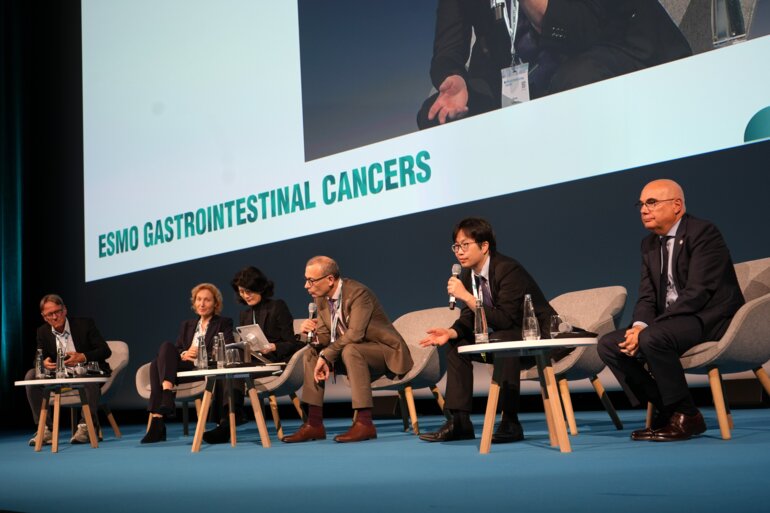
High expectations for the combination therapy have arisen owing to the phase I/II efficacy and safety findings of the trial KRYSTAL-1 trial in heavily pre-treated patients with KRAS G12C-mutated mCRC, reporting a response rate of 46%, median response duration of 7.6 months, and median PFS of 6.9 months, with 16% of patients having grade 3–4 adverse events (N Engl J Med. 2023;388:44–54). “However, that level of benefit was not confirmed in the phase III trial, and was not superior to standard care chemotherapy, so the data are disappointing,” says Prof. Per Pfeiffer from the University of Southern Denmark, and Odense University Hospital, Denmark.
KRYSTAL-10 is a global, open-label, randomised trial of 461 patients with mCRC who had progressed on first-line fluoropyrimidine-based doublet chemotherapy and were randomised 1:1 to adagrasib plus cetuximab (n=231) or chemotherapy with or without vascular endothelial growth factor (VEGF)/VEGF receptor (VEGFR) inhibitor (n=230).
Median PFS per blinded independent central review was 7.5 months with the adagrasib combination versus 8.1 months with chemotherapy (hazard ratio [HR] 0.89; 95% confidence interval [CI] 0.71–1.13; p=0.3241), and median OS (at a minimum follow-up of 35.3 months for OS) was 21.6 months versus 21.7 months, respectively (HR 0.83; 95% CI 0.67–1.03; p=0.0938). No new safety signals were observed.

Figure. Median PFS and median OS in patients with KRAS G12C-mutated mCRC randomised to second-line adagrasib plus cetuximab or chemotherapy in the KRYSTAL-10 trial (ESMO Gastrointestinal Cancers Congress 2026, LBA1)
“It seems that the experimental arm performed as expected based on the phase I/II results, but the chemotherapy arm performed much better than would be predicted based on prior randomised trials,” Pfeiffer points out. “The median survival of 21.7 months with chemotherapy with or without VEGF(R) inhibitor is very difficult to understand, especially as patients with the KRAS G12C mutation tend to have a worse prognosis than those with other KRAS-mutated tumours and wild-type tumours. These patients would be expected to have a median OS of 12–14 months.” Pfeiffer notes that numerically, the OS curve for adagrasib–cetuximab is slightly better than for chemotherapy, but with an hourglass configuration around the median, adding that a longer OS follow-up might prove interesting. “Also, a higher proportion of patients in the chemotherapy arm (30% versus 4%) received subsequent KRAS G12C inhibitor therapy, which may influence OS, but not PFS,” Peiffer observes. Furthermore, there was an indication from a subgroup analysis of the OS data that the adagrasib–cetuximab combination was associated with favourable outcomes in European patients and those with right-sided tumours.
Comparing the data with trials of BRAF-mutated mCRC, it emerges that a median OS of 21.6 months with the adagrasib combination in KRYSTAL-10 would normally be considered an extremely positive outcome for patients with KRAS G12C-mutated mCRC in the second line,” Pfeiffer notes. In the BEACON trial, a combination of the BRAF inhibitor encorafenib and cetuximab prolonged median OS by 3 months compared with standard therapy (8.4 months versus 5.4 months, respectively) in patients with BRAF V600E-mutated mCRC who had disease progression after 1 or 2 previous regimens (N Engl J Med. 2019;381:1632–1643). When encorafenib and cetuximab plus modified FOLFOX6 was given as first-line therapy in the BREAKWATER trial, OS was prolonged from 15.1 months with standard therapy to 30.3 months in patients with BRAF V600E-mutated mCRC (N Engl J Med. 2025;392:2425–2437).
Research into the treatment of RAS-mutated tumours has yielded remarkable results recently, with unprecedented survival data reported from the phase III RASolute 302 trial of the multi-selective RAS(ON) inhibitor, daraxonrasib, in previously treated patients with RAS G12-mutated metastatic pancreatic adenocarcinoma. In the study, median OS was almost doubled, from 6.6 months in the chemotherapy arm to 13.2 months with daraxonrasib (HR 0.40; 95% CI 0.30–0.54; p<0.001), and ORR increased from 11.8% to 33.2% (N Engl J Med. 2026 May 31). “This treatment will also be tested in patients with RAS-mutated CRC, and there is hope they can experience the improvements already seen in patients with BRAF-mutated disease,” concludes Pfeiffer. “Despite the negative results with adagrasib plus cetuximab in KRYSTAL-10, there is excitement and hope for patient with RAS mutations, and we can expect many more trials in this population in the near future.”
Programme details
Tabernero J, et al. Second-line adagrasib plus cetuximab vs chemotherapy in patients with KRASG12C-mutated metastatic colorectal cancer: Results from the KRYSTAL-10 trial. ESMO Gastrointestinal Cancers Congress 2026 - LBA1