An ATOMIC study pre-planned exploratory analysis reports no DFS benefit with the addition of immunotherapy in patients receiving fewer than six cycles of chemotherapy
Atezolizumab plus modified (m) FOLFOX6 has represented a step forward in the treatment of patients with stage III mismatch repair deficient (dMMR) colon cancer, based on the recently-published findings of the ATOMIC study in which the regimen led to a significant 10% improvement in 3-year disease-free survival (DFS; 76.2% for mFOLFOX6 versus 86.3% for mFOLFOX6-atezolizumab) (N Engl J Med. 2026;394:1155–1166). Now, a pre-planned exploratory analysis of the study assessed whether DFS was affected by number of cycles of mFOLFOX6 with or without atezolizumab, reporting that the immunotherapy combination did not provide additional benefit to patients (N=611) who received ≤6 cycles (equivalent to <3 months) of chemotherapy (adjusted HR [aHR] 0.84; 95% CI 0.35–2.01), or who received >12 versus <12 cycles of atezolizumab (aHR 0.81; 95% CI 0.38–1.71) (Abstract 1O).
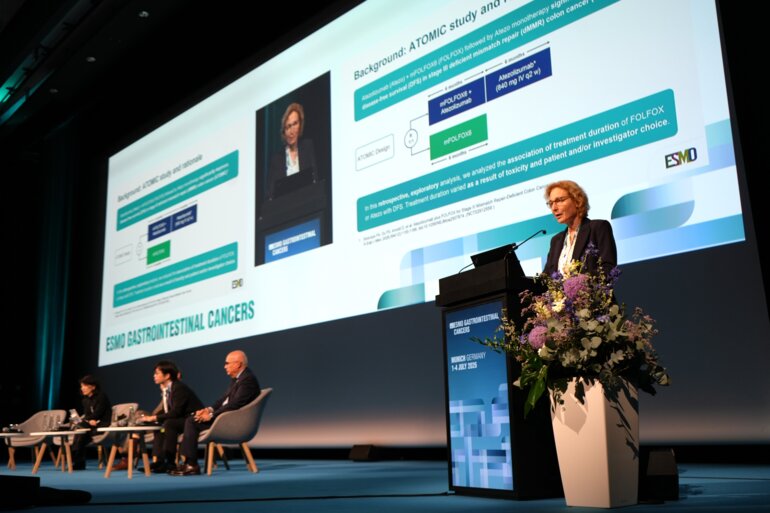
In contrast, as presented at the ESMO Gastrointestinal Cancers Congress 2026 (Munich, 1–4 July), patients who received >6 cycles of mFOLFOX6 experienced improved 3-year DFS with the addition of atezolizumab (aHR 0.45; 95% CI 0.29–0.71; p=0.0005).

Figure. Disease-free survival by mFOLFOX6 duration in dMMR colon cancer in a post-hoc analysis of the ATOMIC study (ESMO Gastrointestinal Cancers Congress 2026, Abstract 1O)
For Dr Guillem Argilés from the Memorial Sloan Kettering Cancer Center, New York, USA, the data are interesting but difficult to interpret and can only be considered hypothesis-generating.
“The ATOMIC trial was designed before the international duration evaluation of adjuvant therapy (IDEA) collaboration results were reported and compared atezolizumab combined with mFOLFOX for 6 months plus atezolizumab continued as monotherapy for a total of 12 months of therapy, with mFOLFOX6 alone for 6 months. Patients did not complete the 6 months of treatment due to toxicity or concomitant health events that precluded the completion of the trial protocol,” he clarifies. “As a consequence, and in spite of the relevant efforts made by the authors in conducting this analysis, there can be a myriad of possible confounding factors that may have contributed to the reported observation.” There is currently a phase II study – the ANTONIO trial (NCT05118724) – evaluating prospectively adjuvant treatment with immunotherapy alone in patients with high-risk stage II or stage III dMMR colorectal cancer ineligible for oxaliplatin-based chemotherapy. “This trial will shed some light on the core research questions of the present work,” adds Argilés.
Balancing adjuvant and neoadjuvant immunotherapy approaches in dMMR colon cancer continues to challenge clinical decision-making. While ATOMIC was a positive phase III trial providing robust evidence of clinical benefit, neoadjuvant treatment strategies have not been evaluated on a similar scale due to the challenges derived from pre-surgical tumour staging and follow up. ATOMIC was conducted over several years during which standard-of-care chemotherapy for patients with dMMR colon cancer evolved, so that 3 months of CAPOX replaced the previous recommendation for 6 months of FOLFOX included in the trial protocol for low- and medium-risk patients (Lancet Oncol. 2020;21:1620–1629). While ATOMIC is a positive phase III trial providing robust evidence of clinical benefit, neoadjuvant treatment strategies have not been evaluated on a similar scale.
“One of the major challenges in optimising treatment for dMMR colon cancer will be to determine whether adjuvant or neoadjuvant therapy will be associated with the greatest clinical benefit, and how this can best be integrated within standard care,” remarks Argilés.
Programme details
Reinacher-Schick A, et al. ATOMIC (A021502/AIO-KRK-0317): Does duration of adjuvant chemotherapy (chemo) or immunotherapy matter? ESMO Gastrointestinal Cancers Congress 2026 - Abstract 1O