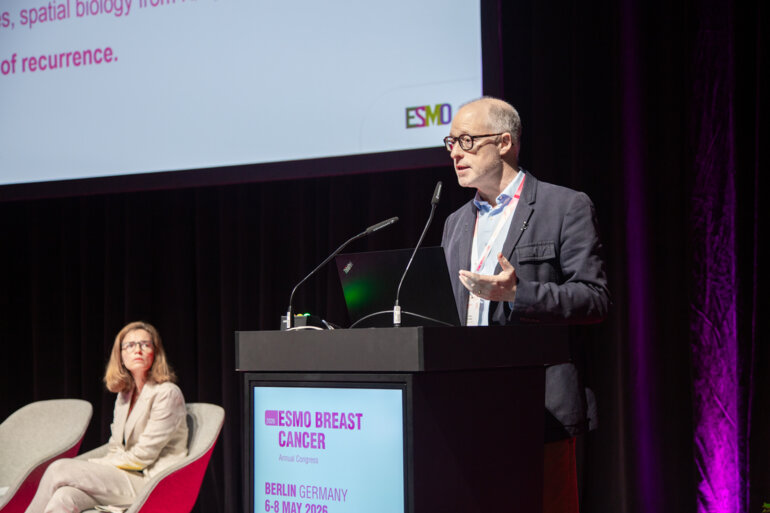


Advances in molecular profiling and a greater understanding of the underlying biology are reinforcing the concept of a distinct disease from other ER-positive breast cancers
Invasive lobular carcinoma (ILC) is diagnosed in 10–15% of breast tumours and is the second most common breast cancer subtype after invasive ductal carcinoma (IDC). ILC predominantly affects postmenopausal women, and the majority of tumours are strongly hormone receptor (HR)-positive/HER2-negative. However, there is notable discordance between ILC low-risk biology and the high tumour burden observed at presentation in many patients; and ILC typically has a higher risk of late recurrence compared with IDC (J Natl Cancer Inst. 2025;117:163–168).
The hallmark molecular feature of ILC is E-cadherin deficiency arising from a loss-of-function mutation in CDH1 (Cancer Treat Rev. 2025;140:103001; Cancers (Basel). 2023;15:5491; Front Oncol. 2021;10:591399). ILC is notoriously difficult to diagnose due to a non-cohesive, single-file growth pattern and lack of a specific mass.
Over the past decade, a greater understanding of the biology of ILC has led to a surge in preclinical studies and retrospective clinical analyses, providing valuable insights into potential therapeutic targets. A comprehensive analysis of ILC genomics reported by The Cancer Genome Atlas (TCGA) Research Network revealed a differing landscape compared to IDC. In addition to increased CDH1 mutations and E-cadherin loss, mutations targeting FOXA1, PTEN and TBX3 are enriched in ILC, while GATA3 mutations occur less frequently than in IDC. The findings relating to FOXA1 and GATA3 are of particular interest as these pioneer transcription factors dictate the oestrogen receptor (ER) axis. As such, these data provided the first suggestion that the ER axis in ILC was potentially different to that in IDC (Cell. 2015;163:506–519).
In the same year, a large BIG 1–98 trial reported a greater magnitude of disease-free survival benefit with adjuvant letrozole compared with tamoxifen in patients with HR-positive ILC versus IDC, suggesting that lobular breast cancer is relatively more resistant to tamoxifen than ductal breast cancer (J Clin Oncol. 2015;33:2772–2779). Further analysis using preclinical models confirmed that the ER axis is different in ILC and is driven by a unique chromatin state associated with increased FOXA1 binding. FOXA1 binding reduces responsiveness to tamoxifen, and studies with clinical samples suggest that the unique FOXA1-ER axis in ILC promotes the transcription of genes associated with tumour progression (Cancer Res. 2022;82:3673–3686).
These findings were confirmed in the TEXT and SOFT clinical trials of premenopausal women; over 13 years of follow-up, significantly greater benefit was observed with the aromatase inhibitor (AI) exemestane compared with tamoxifen (both with ovarian suppression) in patients with ILC, suggesting ILC-specific sensitivity to AI therapy (ESMO Open. 2024;9(Suppl. 4):109O). This was in contrast to the results of a meta-analysis of three large adjuvant trials, which failed to show any difference between ILC and IDC in terms of clinical benefit from AI versus tamoxifen (Cancer Res. 2022;82(4_Suppl):PD14-08), prompting further clinical investigations.
Two ‘window of opportunity’ trials provided clinical evidence that the ER axis differs between breast cancer subtypes, highlighting the need to further investigate response to endocrine therapies in patients with ILC. The randomised, phase II PELOPS trial revealed a significant difference in the cell-cycle pathway response to tamoxifen versus letrozole in ILC versus IDC: in patients with ILC, lack of cell-cycle suppression was observed following tamoxifen, but not letrozole, while in patients with IDC, cell-cycle suppression occurred following both treatments (Clin Cancer Res. 2025;31(12_Suppl):PS18-06). Also, the TBCRC 037 study comparing different endocrine therapies in ILC reported a significantly greater reduction in Ki67 with fulvestrant versus tamoxifen after almost 4 weeks of therapy (p=0.0419), suggesting differential responses to specific endocrine therapies in ILC (Clin Cancer Res. 2025;31(12_Suppl):PS18-09).
Several trials are currently evaluating a number of novel therapies for ILC (Semin Oncol. 2026;53:152466). Based on the finding that ROS1 inhibition is synthetically lethal with E-cadherin loss (Cancer Discov. 2018;8:498–515), two clinical trials investigated the combination of endocrine therapy with ROS1 inhibitors, crizotinib and entrectinib (Clin Cancer Res. 2025;31(12_Suppl):P2-07-24; ESMO Open. 2025;10(Suppl. 4):192MO). Disappointingly, both trials were negative; however, ongoing correlative studies may help elucidate the underlying reasons for these outcomes. In addition, ongoing trials are testing other targets of particular interest in ILC, given the unique genetic landscape of ILC, which includes a higher frequency of mutations in the P13K-AKT pathway and ERBB2 gene. Currently, the LOBSTER neoadjuvant trial is investigating the AKT inhibitor capivasertib (NCT06607757). The HER2 inhibitor, neratinib is also being evaluated in an ongoing neoadjuvant, multicentre study of patients with early-stage HER2-mutated lobular breast cancer (NCT05919108).
Recent preclinical data indicate that the tumour microenvironment (TME) of ILC may also differ from other breast cancer subtypes, and a study utilising spatial transcriptomics to characterise ILC proposes that lobular breast cancers may be classified based on TME architecture (Proc Natl Acad Sci U S A. 2026;123:e2517567123). These findings suggest that the TME may be a logical therapeutic target for future clinical investigation.
While historically, lobular breast cancer has presented several unique diagnostic and treatment challenges, valuable insights from many preclinical genomic investigations and successful collaborations among the lobular breast cancer community are now driving the field forward. With a growing appreciation of the distinct genomic and transcriptomic landscape of ILC, future management of the disease is likely to differ in many respects from that of other ER-positive breast cancers.
Programme details
Jeselsohn R. Lobular breast cancer: Special treatment considerations (+ novel). ESMO Breast Cancer 2026. Keynote Lecture