Can artificial intelligence finally unlock the full potential of cancer genomics? Discover how new digital tools are closing the gap between data and clinical action in oncology.
Author: James Creeden MD PhD, Co-CEO, Qnomx AG
The content of this article was provided by Qnomx and reflects the views of the author/company. ESMO does not endorse the content of this publication and does not take any responsibility for the accuracy, completeness or reliability of the information contained in such article.
Genomics has transformed how we understand cancer biology and make treatment decisions in oncology. Advances in next-generation sequencing (NGS) have made comprehensive molecular profiling far more accessible, revealing actionable variants and guiding targeted therapies for patients around the world. Yet despite clear clinical benefit, the promise of genomics-guided oncology remains only partially fulfilled. According to Anderson et al. (1), while up to 80% of patients harbour at least one actionable alteration, only a minority ultimately receive genomics-informed care.
In our daily work with clinical laboratories and oncology teams, we see that the real bottleneck is not sequencing - it’s too often interpretation. NGS reports often run to dozens of pages, dense with information on variants, molecular signatures such as tumour mutational burden or microsatellite instability, the requisite list of VUS and a constant flow of new evidence from the literature. Turning that complexity into clear therapeutic insights, particularly in local languages, can take hours per case and demands expertise that remains in short supply globally. (2,3,4)
As Friedrich et al. note, the shortage of professionals with combined genomics and clinical interpretation skills is a critical limiting factor. As a result, much of the valuable information already being generated goes unused, and many potentially actionable findings are delayed. Even large cancer centres can review only a fraction of their most complex cases in multidisciplinary tumour boards each week, and community oncologists typically don't have access to these. (5)
This challenge is compounded by the lack of standardised report formats, differing national language requirements, variations in how labs present evidence and constantly evolving therapy options and guidelines. Consistency and reproducibility are difficult to maintain. The gap between sequencing data and clinical action is, in effect, limiting both the scalability and equity of precision oncology.
Artificial intelligence (AI) and digital oncology tools are now emerging to bridge that gap. When designed responsibly and trained on clinically curated data, AI can help standardise interpretations, integrate the latest research in real time, and relieve some of the cognitive burden on experts. Generative AI and large language models show particular promise in summarising complex reports and placing results in the right clinical context for human review. (6)
At the same time, we observe that many clinicians and laboratory staff, under pressure to manage growing workloads, have started using publicly available AI chatbots to interpret reports. As Menz et al. report (7), this trend reflects both the urgency of the challenge and the lack of regulated, domain-specific tools. It also raises serious issues of data privacy, source reliability, and compliance with regulations such as the IVDR and the EU AI Act.
The path forward will require deeper collaboration between oncologists, molecular scientists, and AI developers. In our experience, the most meaningful progress happens when clinicians shape the design and validation of these systems and work closely with regulators to ensure feasibility. Addressing the interpretation gap in cancer genomics is one of the defining challenges in digital oncology today. With clinical rigor and responsible innovation, AI can help close that gap to make precision oncology faster, more consistent, and more widely accessible.
References
- Anderson E.C. et al, Genome-matched treatments and patient outcomes in the Maine Cancer Genomics Initiative (MCGI) 10.1038/s41698-024-00547-4 https://www.nature.com/articles/s41698-024-00547-4
- Hofman & Esposito, The Role of Algorithms in Molecular Tumour Boards—Managing the Gap Between Research and Clinic in Precision Medicine https://pmc.ncbi.nlm.nih.gov/articles/PMC12047614
- Gibbs et al, 2023, Comprehensive Review on the Clinical Impact of Next-Generation Sequencing Tests for the Management of Advanced Cancer https://pubmed.ncbi.nlm.nih.gov/37285561/
- Morash M et al, The Role of Next-Generation Sequencing in Precision Medicine: A Review of Outcomes in Oncology, J Personalized Med (2018) https://pubmed.ncbi.nlm.nih.gov/30227640/
- Volders P.-J. et al, A nationwide comprehensive genomic profiling and molecular tumor board platform for patients with advanced cancer, npj Precis. Onc. (2025) https://www.nature.com/articles/s41698-025-00858-0
- Kundu, S. Communications Medicine 1:8 (2021) https://www.nature.com/articles/s43856-021-00003-5
- Menz BD et al, Generative AI chatbots for reliable cancer information: Evaluating web-search, multilingual, and reference capabilities of emerging large language models, Eur. J. Cancer (2025) https://pubmed.ncbi.nlm.nih.gov/39922126/
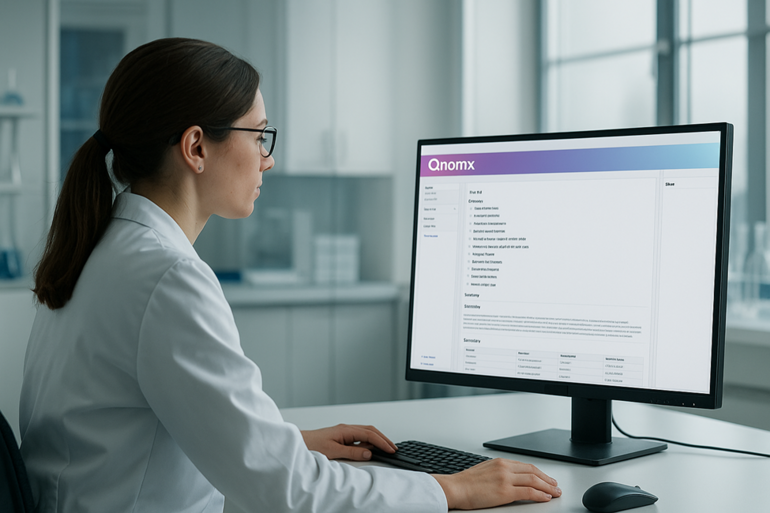
Qnomx is a Swiss-based, GDPR-compliant precision oncology company leveraging AI to automate genomic interpretation in cancer diagnostics. Its platform transforms complex next-generation sequencing (NGS) data into standardized, clinically actionable reports, supporting laboratories and oncologists in efficient and consistent therapy selection.