
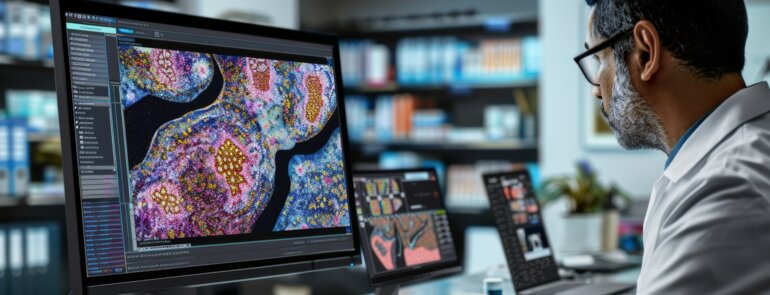
Integrating artificial intelligence into pathology routine workflows could optimise patient selection for immunotherapy
Artificial intelligence (AI) algorithms can provide reliable PD-L1 scores, minimising variability and supporting pathologists specifically in difficult cases, according to findings from a study published in the ESMO Real World Data and Digital Oncology (ESMO Real World Data and Digital Oncology, Volume 10, 100181 ).
Manual quantification of PD-L1 expression is vulnerable to high interobserver variability especially when scores are low and near the cut-off values, which can ultimately impact patient eligibility to immunotherapy (Histopathology. 2022 Dec;81(6):732-741 ).
In a multicenter study, the AI-based DiaKwant PD-L1 algorithm, which was developed for the quantification of PD-L1 expression through the CPS across various solid carcinomas, demonstrated to be non-inferior to pathological routine scoring method.
This study included 142 patients diagnosed with various carcinomas who underwent surgical resection or biopsy, with PD-L1 scoring (combined positive score (CPS)) carried out using standardized IHC protocols and manual scoring by pathologists. Histopathological slides obtained during routine diagnostic procedures were collected retrospectively, and then digitalised.
Manual and AI scores were compared with the gold standard. AI achieved higher accuracy (88% versus 75%) and sensitivity (96% versus 78%) than manual scoring across multiple tumor types and staining platforms.
The DiaKwant PD-L1 algorithm adds to other AI-powered CPS solutions investigated recently, which promise to impr. “AI-assisted PD-L1 scoring significantly reduces variability among pathologists, especially near critical clinical thresholds, improving consistency in challenging cases,” comments Dr Rodrigo Dienstmann, working at the Oncoclínicas & Co, Brazil, and Vall d’Hebron Institute of Oncology, Spain, and Editor-in-Chief of the ESMO peer-reviewed journal. “These results suggest that integrating AI into routine workflows could optimise patient selection for immunotherapy and streamline pathology practice.”